
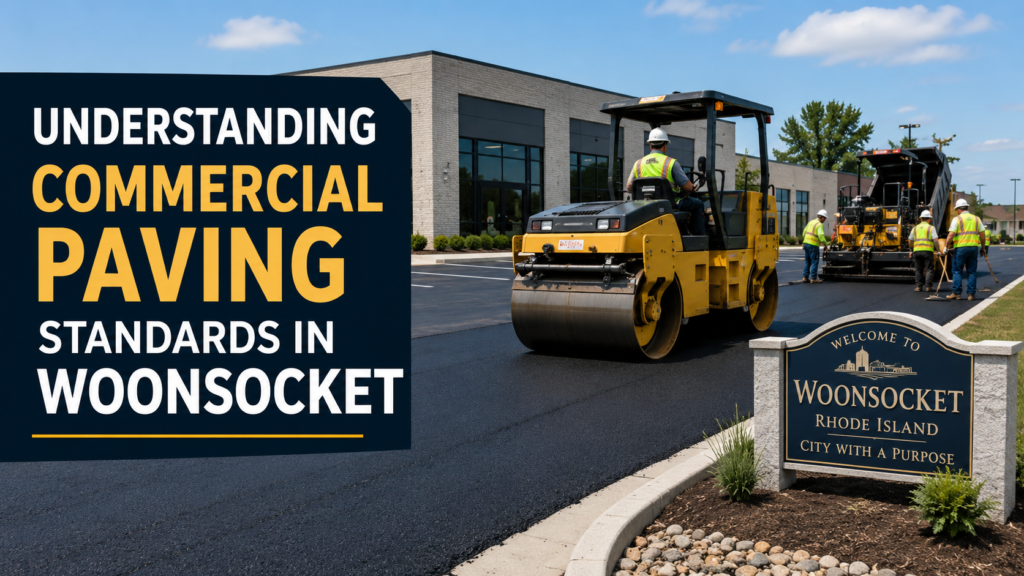
Paving a business property involves a set of engineering and planning considerations that go well beyond what’s needed for a home driveway. Commercial sites carry heavier and more frequent traffic, need to comply with accessibility and safety codes, and often serve as the public face of a business every single day. In Woonsocket, where commercial properties range from retail storefronts and medical offices to warehouses and multi-tenant plazas, understanding what separates commercial-grade paving from residential paving helps property owners and facility managers plan projects that hold up under real-world use.
What Makes a Site “Commercial Grade”
Several factors distinguish Commercial Paving Woonsocket projects from smaller residential ones:
- Load-bearing design. Commercial lots must be engineered to handle everything from daily passenger vehicle traffic to periodic deliveries by box trucks or waste collection vehicles. This requires a thicker, more robust base and surface course than a typical driveway.
- Drainage planning at scale. Larger paved areas generate more stormwater runoff, so drainage systems need to be designed to move water efficiently across the entire site without creating pooling or erosion at the edges.
- Accessibility compliance. Commercial properties open to the public are generally required to provide accessible parking spaces, curb ramps, and routes that meet current accessibility standards, all of which need to be planned into the paving layout.
- Traffic flow and safety design. Entry and exit points, fire lane access, and pedestrian pathways all need to be considered so the finished lot functions safely for the volume of people and vehicles using it.
The Commercial Paving Process
While the general sequence of paving work is similar across residential and commercial projects, the scale and precision required for commercial sites is considerably greater. A typical commercial paving project includes:
- Site assessment. This includes reviewing the existing surface and subsurface conditions, soil composition, and drainage patterns across the property.
- Design and layout planning. Traffic flow, parking configuration, accessible routes, and fire lane requirements are mapped out before any construction begins.
- Excavation and base preparation. Old pavement is removed if necessary, and a properly compacted aggregate base is installed to support the anticipated traffic load.
- Asphalt installation. Hot-mix asphalt is laid in one or more lifts, depending on the specified thickness, and compacted with rollers to achieve the required density.
- Striping and signage. Once the surface has cured sufficiently, parking spaces, fire lanes, directional arrows, and accessible parking symbols are painted according to code requirements.
Managing Business Disruption During Construction
One of the more practical concerns for commercial property owners is how to keep a business operating while paving work is underway. Established paving contractors generally offer several approaches to minimize disruption, including phased construction that keeps part of a lot open while another section is being worked on, scheduling major work during off-peak hours or weekends, and clear communication timelines so tenants and customers know what to expect. Planning this logistics piece in advance, rather than as an afterthought, tends to produce a smoother project overall.
Frequently Asked Questions About Commercial Paving
How is commercial asphalt different from what’s used on driveways?
Commercial-grade asphalt mixes are typically formulated and installed to handle heavier, more frequent traffic loads. This often means a thicker base, a denser compaction standard, and sometimes a different asphalt mix design compared to what’s used for lighter residential applications.
How long does a commercial paving project typically take?
Timelines vary significantly based on the size of the property, the condition of the existing surface, and weather conditions. Smaller lots may be completed within a matter of days, while larger, multi-phase commercial properties can take considerably longer. A site assessment early in the process gives a much clearer picture of the expected schedule.
Does commercial paving need to account for stormwater regulations?
In many municipalities, larger paved surfaces are subject to stormwater management requirements designed to prevent runoff from overwhelming local drainage systems. Commercial paving projects often need to incorporate grading and, in some cases, drainage infrastructure that satisfies these local requirements.
What causes commercial parking lots to fail prematurely?
The most common causes include inadequate base compaction, poor drainage planning that allows water to infiltrate the pavement, underestimating the traffic load the lot will actually experience, and skipping routine maintenance like sealcoating and crack sealing after installation.
Accessibility and Code Compliance
Because commercial properties are generally open to the public, paving projects need to account for accessibility requirements from the outset. This typically includes properly sloped accessible parking spaces, curb ramps at building entrances, and clearly marked accessible routes free of obstructions. Retrofitting these elements after a lot is paved is far more difficult and costly than incorporating them into the original design, which is why accessibility planning is usually addressed during the design phase rather than after construction.
Lifespan Expectations for Commercial Pavement
Understanding realistic lifespan expectations helps property owners plan long-term maintenance budgets more effectively. A commercial lot built with proper base preparation and appropriate asphalt thickness for its traffic load can generally perform well for fifteen to twenty years before requiring major reconstruction, provided routine maintenance like sealcoating and crack sealing is performed consistently along the way. Lots that see heavier truck traffic, or that were built without adequate consideration for that traffic, often show wear on a shorter timeline, which is part of why accurately assessing anticipated use during the design phase has such a significant impact on long-term performance.
Coordinating Paving With Other Property Improvements
Commercial paving projects sometimes coincide with other property improvements, such as updated landscaping, new exterior lighting, or building facade work. Coordinating the timing of these projects can reduce overall disruption and avoid situations where newly paved surfaces are damaged by subsequent construction activity. Property owners planning multiple improvements often find it worthwhile to sequence the work so that paving happens after other construction activities that might involve heavy equipment crossing the site, protecting the investment in the new pavement.
Why Base Preparation Is the Foundation of Long-Term Performance
Regardless of how much attention goes into the surface layer, a commercial lot’s long-term durability comes down to what lies beneath it. A properly compacted aggregate base distributes vehicle loads evenly and resists the shifting and settling that leads to cracking and potholes. In Woonsocket’s climate, with its seasonal freeze-thaw cycles, base preparation becomes even more critical, since inadequately compacted material is more prone to movement as the ground freezes and thaws repeatedly through the winter months.
Maintenance Planning for Commercial Properties
A commercial lot represents a significant capital investment, and a proactive maintenance plan protects that investment over time. Routine practices that extend pavement life include periodic sealcoating to shield the surface from UV exposure and chemical spills, prompt crack sealing before minor cracks widen into structural problems, and regular inspection of drainage points to confirm water is flowing away from the pavement as intended. Many property managers find it useful to schedule these inspections seasonally, particularly before and after winter, when freeze-thaw stress is at its highest.
Materials Commonly Used in Commercial Paving
Commercial paving projects typically rely on hot-mix asphalt as the primary surface material, valued for its durability, relatively efficient installation, and flexibility in handling temperature fluctuations. Within that category, though, mix designs vary considerably. Heavier-duty mixes with larger aggregate and denser binder content are often specified for areas that see truck traffic, loading docks, or drive-through lanes, while standard mixes are typically sufficient for general parking areas used primarily by passenger vehicles. Some commercial projects also incorporate concrete in specific high-stress zones, such as dumpster pads or areas exposed to significant point loads, since concrete resists the localized indentation that can occur with asphalt under sustained heavy weight.
Evaluating a Paving Contractor’s Approach
Commercial property owners benefit from understanding what a thorough, professional paving process actually looks like before work begins. A detailed approach typically includes a documented site assessment covering soil conditions, drainage patterns, and existing pavement condition, a clear project timeline that accounts for weather contingencies and any phased construction needs, and transparent communication about how accessibility and code requirements will be addressed in the final layout. Contractors who walk through these details proactively, rather than waiting to be asked, are generally signaling a more thorough and considered approach to the work.
The Role of Traffic Studies on Larger Properties
For larger commercial developments, particularly retail centers, medical campuses, or multi-tenant properties, understanding actual traffic patterns before finalizing a paving layout can meaningfully improve how well the finished lot functions. This might involve observing how vehicles currently move through the site, identifying congestion points near entrances or drive-throughs, and considering how delivery vehicles or waste collection trucks navigate the property differently than everyday customer traffic. Incorporating these observations into the paving and striping plan helps prevent recurring congestion or safety issues that are far more difficult to correct after the pavement is in place.
Planning a Commercial Paving Project
Every commercial property has its own combination of traffic patterns, drainage challenges, and accessibility needs, which is why a thorough site assessment is typically the first step in any project. Property owners who understand the fundamentals of load-bearing design, drainage planning, and accessibility compliance are better equipped to evaluate proposals and ask informed questions. For businesses in Woonsocket exploring commercial paving in Woonsocket, starting with a clear-eyed assessment of the property’s current condition and anticipated use makes it far easier to plan a lot that performs well for years rather than one that requires early, costly repairs.